Monday, October 12, 2015

LOCUS "Keeping Current" Happy Hour III on 10/22

Wednesday, October 22, 2015
6:00pm - 7:30pm
Green Spoon Cafe
Register online!

*This event is organized for and by people of color (and non-POC with other marginalized identities) as a supportive and courageous space.
LOCUS invites you to a casual autumn Keeping Current" Happy Hour III! Taking a few pages (and no more than that!) from the book club model, our prompts for light conversation include a recommended reading list of articles and videos covering recent and current events related to equity and inclusion. 
Join us at Green Spoon Cafe on Wednesday,October 21 from 6:00pm - 7:30pm to enjoy drinks and appetizers, discuss the Recommended Reading List and other related questions, and to connect with great local leaders of color!
Keeping Current III Happy Hour Reading List:
*Event attendees are responsible for the cost of their meals and beverages.

Thursday, June 4, 2015

LOCUS "Keeping Current" Happy Hour II on 6/22

LOCUS "Keeping Current" Happy Hour II

*This event is organized for and by people of color (and non-POC with other marginalized identities) as a supportive and courageous space.
On the heels of "Putting Into Words What I Live" and "Intersectionality with Intentionality" workshops focused on microaggressions, code-switching, and navigating multiple intersecting identities, LOCUS invites you to a casual summertime "Keeping Current" Happy Hour II! Taking a few pages (and no more than that!) from the book club model, our prompts for light conversation include a recommended reading list of articles and videos covering recent and current events related to equity and inclusion. 
Join us on the patio (or indoors in the case of inclement weather) at Afro Deli Coffee Minneapolis on Monday, June 22, from 6:00pm - 7:30pm to enjoy drinks and appetizers, discuss the Recommended Reading List and other related questions, and to connect with great local leaders of color! Register online at Eventbrite.
Keeping Current II Happy Hour Reading List:

*Event attendees are responsible for the cost of their meals and beverages.

Friday, May 29, 2015

“Intersectionality with Intentionality” Recap

On May 19th, LOCUS held an event on code-switching called "Intersectionality with Intentionality." We started the event with delicious food from Chelle’s Kitchen and the ice breaker “Who are you?” allowing people to get to know each other and reflect on ways they identify themselves. After the icebreaker, Diane and Rashanda started their presentation by screening Key and Peele’s “Phone Call” video which prompted much laughter among the participants. In response, an attendee noted that in their experience, people tend to switch their tones and attitudes when they are around people we personally identify with. On the same topic, another attendee noted that this may occur because we project what we think we're supposed to be behaving like.


Afterwards, the group started discussing the positive and negative aspects of code-switching. Some positives of being able to code-switch were identified as flexibility, credibility, empathy, and understanding. On the other hand, some negatives of code-switching were identified as inauthenticity, threat to credibility, and difficulty being one’s whole self. After discussing the multifacetedness of code-switching, the participants began to address ways that we can become comfortable with code-switching. Some said that it requires caring less about what others think about you. Some said that friends and family can help you become comfortable, which also led to a discussion about how witnessing your loved ones code-switch can be a challenge or advantage to deciphering the authenticity of others.


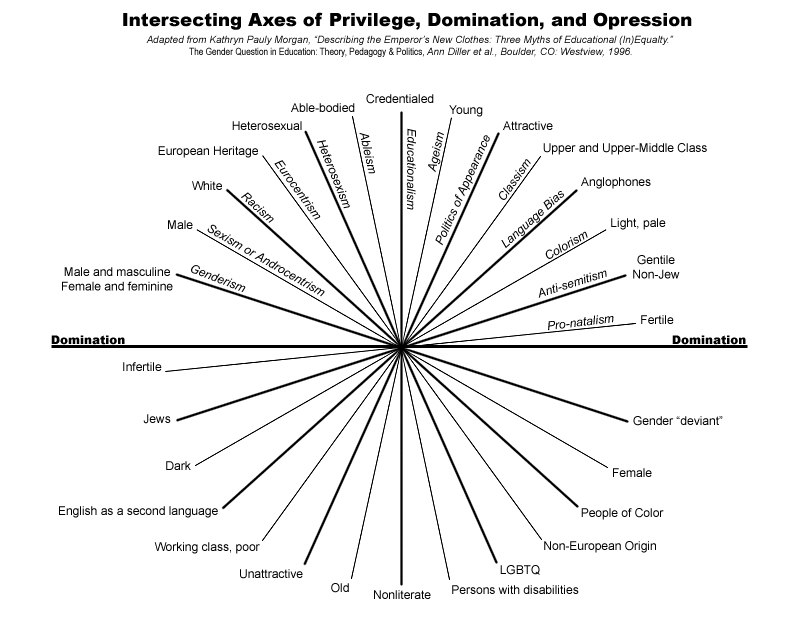
Diane and Rashanda then dove into the framework of kyriarchy, a term coined by Elisabeth Schussler Fiorenza in 2001 and described as a “complex pyramidal system of intersecting multiplicative social structures of superordination and subordination, of ruling and oppression.” This concept really helped the participants better understand the complexity of our identities, as author, Sian Ferguson, describes how kyriarchy builds on intersectional feminism:

1. It acknowledges that gender-based oppression is not the only type of oppression that exists.

2. It acknowledges that one can both benefit from and be oppressed by the system.

3. It could suggest why so many oppressed people are complicit in their own oppression.

4. It does not erase people who do not identify as men or women.

5. It acknowledges that oppressions are interlinked.


In order to reflect on our individual experiences within the kyriarchy framework, the participants engaged in an activity where we had to place ourselves on the kyriarchy diagram. The activity brought up an interesting discussion about how these labels can have different meanings within various cultures or individual perspectives and how that can influence someone to choose their place within the diagram. For example, someone might be labeled having “light” skin in their community; however, within the context of the diagram they might be labeled having “dark” skin.


At the end of the event, everyone was asked to identify one aspect of the discussions they would take away from the event. People said they would take away:
  • the more positive aspects of code-switching
  • the value in having multiple identities
  • language around describing code-switching
  • different ways to share the content with others
  • the significance of having self-awareness
  • better understanding of feminism/kyriarchy
  • more questions about the topic
  • a sense of struggle because privilege is a part of oneself that’s difficult to identify with
  • the welcoming nature of the LOCUS space
  • the perspective that it can be a privilege to have the agency to code-switch
  • gratitude of having knowledge around code-switching


When asked for one question that the participants still had, they said:
  • How do I use my systemic privileges to benefit the oppressed?
  • How can I bring more of those identities to spaces at work?
  • When do you decide to take the risk not to switch, to really show up?
  • How can I be more mindful about helping others to be more mindful?
  • How can I understand when I'm code-switching and when I don't need to be doing it?
  • How do I share this information with other people and not shame them?
  • How can I be a better ally?
  • How do talk to people about the nuances or fluidity of identities?
  • Where are the men in the room?
  • How do we create the space for code-switching to be an asset?
  • In what ways can I not only challenge the system but also challenge the arbitrary middle ground?
  • As a privileged person, what space am I welcome in?
  • When is it appropriate to push back?
  • What level of conflict is okay, to bring up people's voices who are not at the table?
  • What do you call someone who fights this [system]?
  • How do you spread this information about this?
  • How do you bring this conversation to spaces of privilege?
  • What is the intention behind code-switching?
  • Does this work as a baseline for understanding these oppressions?
  • How do we push this conversation to a next level?


Thank you everyone for such a lively and insightful discussion. We look forward to having more in the near future!


Friday, April 24, 2015

"Intersectionality with Intentionality" on Tuesday, May 19

"Intersectionality with Intentionality"
Tuesday, May 19
5:15pm Registration; 5:30pm - 7:30pm Program
Minnesota Council of Nonprofits
2314 University Ave. West #20, St. Paul, MN 55114
Register online.
Admission: $7.00/$10.00


*This event is organized for and by people of color as a supportive and courageous space.

In an increasingly diversifying society, our lives and identities are hyphenated and nuanced, posing a challenge to our capacity for identity-driven leadership. The paradox of being part of the "in" group at times and being seen as the "other" at other points adds to the complexity.

Do you struggle with authentically being yourself in any context? Perhaps your conversation, use of language, and expression are different with your coworkers as opposed to with your friends? Code-switching, the practice of shifting the languages you use or the way you express yourself in your conversations, serves to provide an explanation for this behavior.

Though this ability to blend in and adapt in order to survive in our various surroundings could be likened to a superpower, it's not without trade-offs. Working overtime to assimilate and acculturate can create a sense of isolation and diminish our self-knowledge and self-trust.

Join LOCUS on Tuesday, May 19 from 5:30pm - 7:30pm at the Minnesota Council of Nonprofits for a stimulating conversation at "Intersectionality with Intentionality," where we'll explore code-switching, the inherent compromises it places on our authenticity, and a framework for understanding and navigating the implications of intersectional identities.

---

Light refreshments will be provided. Register early as there are a limited number of seats! 

LOCUS seeks to serve as a meeting ground for people from diverse backgrounds to engage with one another and to clarify our collective needs and our common aspirations. Through the pursuit of stronger connection and inclusiveness, and by striving for equitable and representative leadership, we aim to create a community that embraces and supports everyone. Join us at http://locusmn.blogspot.com/!

Thursday, April 23, 2015

“Putting Into Words What I Live” Workshop Recap

Building on our Mini-Microaggressions Film Festival in October,  LOCUS held a facilitated discussion on microaggressions at Rondo Community Outreach Library last week. Once again, Chelles' Kitchen provided a delicious meal while guest facilitator Alicia Sojourner, Racial Justice and Public Policy Program Coordinator at the YWCA of Minneapolis, shed light on the history, origination and impact of microaggressions in communities of color and society as a whole. We started the evening by spending some time on the definition of microaggressions.


Microaggressions: “Brief and commonplace daily verbal, behavioral, or environmental indignities, whether intentional or unintentional, that communicate hostile, derogatory, or negative racial slights and insults toward people of color”- Professor Derald Sue

While unpacking the definition above, Alicia opened discussion for attendees to share their own personal experiences with microaggressions. She challenged the group to not only think of instances where we were on the receiving end of microaggressions, but when we have been the perpetrator of such acts. This expanded the conversation to discuss how we as communities of color also allow and perpetuate stereotypes and use them against one another.

In order to confront microaggressions, Alicia provided the group with 5 teachings on how to begin conversations to address them when they occur:

1.                  Questioning
Asking questions to compel the perpetrator to think about their comments/actions and to navigate and unpack the meaning of the behavior. This allows for an open dialogue.

2.                  Empathetic Relating
By turning the situation around on the perpetrator, you allow them to put themselves in your shoes by perhaps asking if they have ever experienced or received that comment or question, and if so what their response would be.

3.                  I Feel
Using “I feel” statements (typically toward close co-workers, friends and people from one’s own community) to explain to the perpetrator the impact that microaggression has on you personally.

4.                  Educating
Using microaggressions as teachable moments is most effective when used after steps 1-3, and includes explaining the definition and theory of microaggressions.

5.                  Returning Later
When on the receiving end of a microaggression, sometimes you need to practice self-care by removing yourself from the situation without addressing it at that moment. This offers time to think of how to address it at a later time after you’ve had a chance to gather your thoughts. The key is, you must return later, otherwise you have granted permission. You have allowed any and all of the “isms” to occur.


Alicia then facilitated a paired role-playing activity where participants navigated conversations where one partner is on the receiving end of a committed microaggression by the other partner. We were challenged to address the microaggression with one of the above techniques. The role-play was eye-opening and gave us a chance to begin to incorporate some of the language and practices that can help to confront and overcome microaggressions.

Thanks again to Alicia for facilitating such meaningful dialogue and to the participants for sharing their personal stories and insights.
Monday, March 30, 2015

"Putting Into Words What I Live" on Wednesday, April 15


"Putting Into Words What I Live"
Wednesday, April 15, 2015
5:15pm Registration; 5:30pm - 7:30pm Program
Rondo Community Outreach Library
Register online by 4/14. 
Admission: $7.00/$10.00

*This event is organized for and by people of color as a supportive and courageous space.
Microaggressions—"everyday slight, putdown, indignity, or invalidation unintentionally directed toward a marginalized group." When does it exactly happen? How can we identify it? How can we deal with it?
Building on our Microaggressions Mini Film Festival, LOCUS invites you to participate in a discussion where we will explore the language, theories and implications of this phenomenon. Alicia Sojourner will present on fundamental concepts of microaggression to help us better understand this topic. Afterwards, Alicia will facilitate a personal reflection time and group discussion on how we can effectively put into words our lived experiences and deal with microaggressions in our everyday lives.
aliciaf.jpg
Alicia serves as the Racial Justice and Public Policy Program Coordinator at the YWCA. She has many years in education and public policy. Alicia currently uses her background in grassroots community and political organizing for early childhood education, disability rights, and racial equality to inspire others to be change agents in the YWCA community, as well as their own.
Light refreshments will be provided. Register early as there are a limited number of seats!


LOCUS seeks to serve as a meeting ground for people from diverse backgrounds to engage with one another and to clarify our collective needs and our common aspirations. Through the pursuit of stronger connection and inclusiveness, and by striving for equitable and representative leadership, we aim to create a community that embraces and supports everyone. Join us at http://locusmn.blogspot.com/! 

Tuesday, February 24, 2015

Announcing Two Community Engagement Funding Opportunities

The Alliance for Metropolitan Stability announces two funding opportunities for organizations and individuals to conduct community around the proposed North Minneapolis Greenway. See below for details on both opportunities and consider applying!


The Alliance for Metropolitan Stability, in partnership with the City of Minneapolis and the Northside Greenway Council, is pleased to announce two funding opportunities for organizations and individuals to do community engagement around the proposed North Minneapolis Greenway. 

Application for Micro-grants to Organizations: 

We are accepting applications from community organizations to share information and gather input from north Minneapolis residents along the proposed greenway. Community organizations must be either nonprofit 501.c 3 organizations or have a fiscal sponsor that is a nonprofit organization. Community organizations will also be expected to present information and gather input in a neutral way. Target groups can include:
  • Residents living directly on the existing proposed greenway route (a primary target group north of Plymouth)
  • Residents of the Sumner-Glenwood, Harrison, and Near North/Willard Hay neighborhoods (south of Plymouth Ave)
  • The larger north Minneapolis community, with an emphasis on the following Northside residents: African-American, Asian American and Pacific Islander, Latino, Native American, people with disabilities, people who do not speak English as a first language, other cultural communities, youth, older adults, people with limited or no access to a vehicle, renters, other groups that were not well-represented in previous engagement efforts
Organizations reaching out to residents north of Plymouth may apply for grants of $500 up to $5,000 to conduct engagement. Because of the breath of work that needs to take place south of Plymouth to ensure that the engagement process is as thorough and complete as it has been in previous rounds of engagement north of Plymouth, organizations reaching this geographic area may apply for awards up to $10,000, with a total award proportional to the size of the population targeted. Approximately $51,000 is available. For more information and to access the application, please click here.

Application for Community Connectors:
We are also accepting applications for six Northside Greenway Council Community Connectors. Community Connectors are individuals who will work to raise awareness, provide education and gather general feedback around the proposed Greenway project in specific communities in North Minneapolis. These positions will be directly supervised by a community-based organization.

In engagement efforts from 2014, the Greenway Council was able to garner significant feedback representative of the diverse North Minneapolis community compared to engagement efforts in the past. However, there are still significant gaps in representation from many racial, cultural, and otherwise specific constituencies. To that end, we are looking for Community Connectors to do a deeper round of engagement, working specifically with the following demographics in North Minneapolis: African and African Americans, Asian American and Pacific Islanders, Latinos, Native Americans, people who do not speak English as a first language, other cultural communities, people with limited or no access to a vehicle, and people with disabilities.

Six individuals will be selected to receive an estimated stipend of $2,550 each to conduct engagement activities. For more information and for the application, please click here.

There will also be an information meeting for all interested applicants of both funding pools on Wednesday, March 4 from 3.30 - 5 p.m. at North Commons Park (1801 James Ave N, Minneapolis).
Applications are due by 5 p.m. Friday, March 27 and should be emailed to Ebony Adedayo - ebony@metrostability.org. 

 The Greenway Steering Committee is now on Facebook. Be sure to like us!